Strategic Intelligence Cycle
A framework for thinking strategically in complex contexts
By: Alejandro Martínez Gómez
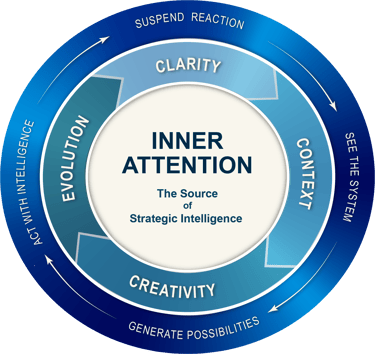
Clarity
The ability to suspend automatic reactions and regain perspective. Without clarity, any decision is built on a limited perception.
Context
The ability to understand the entire system in which the problem occurs. Not only what is obvious, but also what is unseen: relationships, tensions, history.
Creativity
When understanding expands, previously invisible possibilities emerge. Not as a result of creative effort, but as a consequence of seeing more clearly.
Evolution
Decisions cease to be reactive and become more precise interventions, capable of generating sustainable changes in the system.


At the heart of the model is an element that is often ignored in many strategic approaches: the quality of the leader's attention.
Strategic intelligence does not arise solely from analysis.
It also stems from the ability to broaden perception, think unconventionally, and adapt clearly to the situation when making decisions.
In this sense, strategic leadership is less about applying formulas and more about a discipline of observation, understanding, and conscious decision-making.
Many of the problems organizations face today are not information problems. They are problems of understanding.
Despite having data, analysis, and experience, management teams still struggle to make clear decisions in critical moments.
This is because, in complex contexts—and especially in family businesses—decisions don't depend solely on objective variables.
They also depend on invisible dynamics:
Power dynamics
Shared histories
Different interpretations of the same reality
Unexpressed tensions
In these types of environments, reacting quickly often generates fragmented responses that end up amplifying the problem.
Faced with this challenge, the Strategic Intelligence Cycle™ is not simply a model.
It is a discipline of thought.
A way to regain clarity before intervening.
The cycle is structured in four stages that should not be understood as linear steps, but rather as capabilities that develop in parallel:
This insight is part of an exploration of Strategic Intelligence:
how to perceive, understand, and act in complex environments.
Every process begins with a conversation.
Some of the institute's conceptual developments are not publicly available, but they can be shared depending on the context.
Other insights that can expand on this reflection:
• Strategy Begins Where Reaction Ends
• Governance in Family Businesses
This content was originally developed in Spanish. View the original version: alemartinstitute.com/strategic-intelligence-cycle
Alemart Institute
Strategic clarity for leaders and family businesses


© 2026 Alemart Institute. All rights reserved.
Contact
Location